


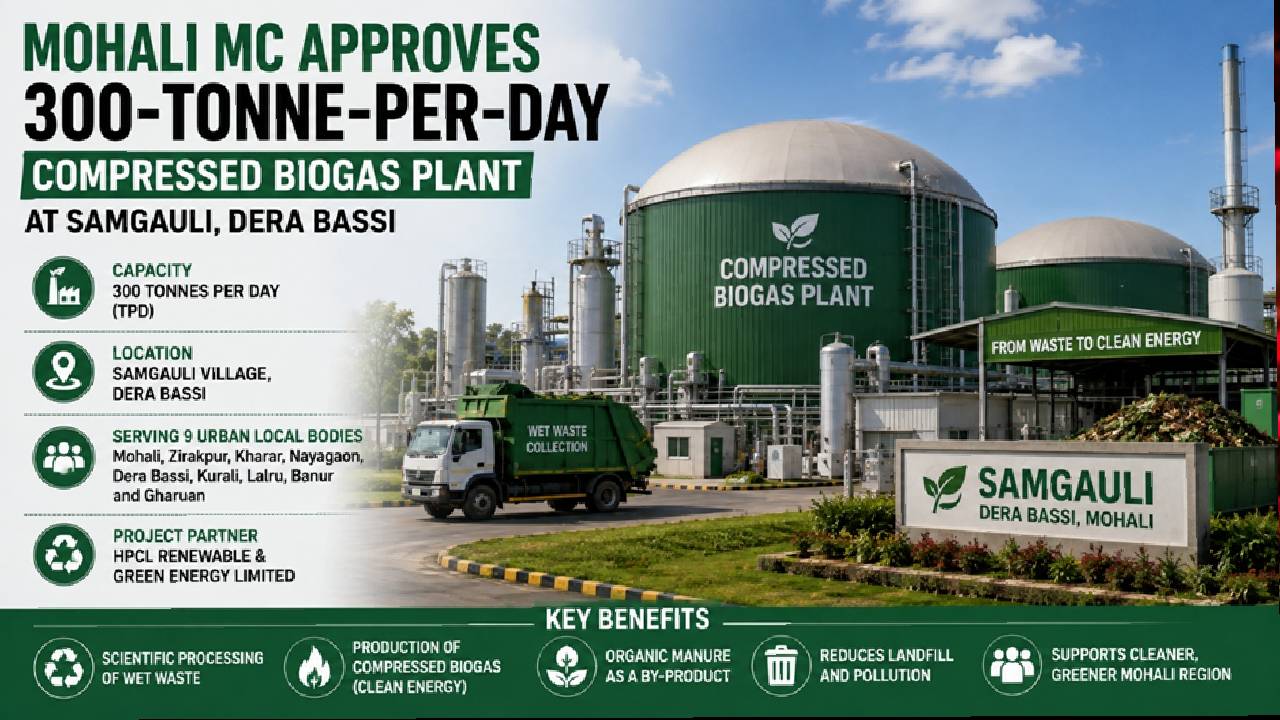
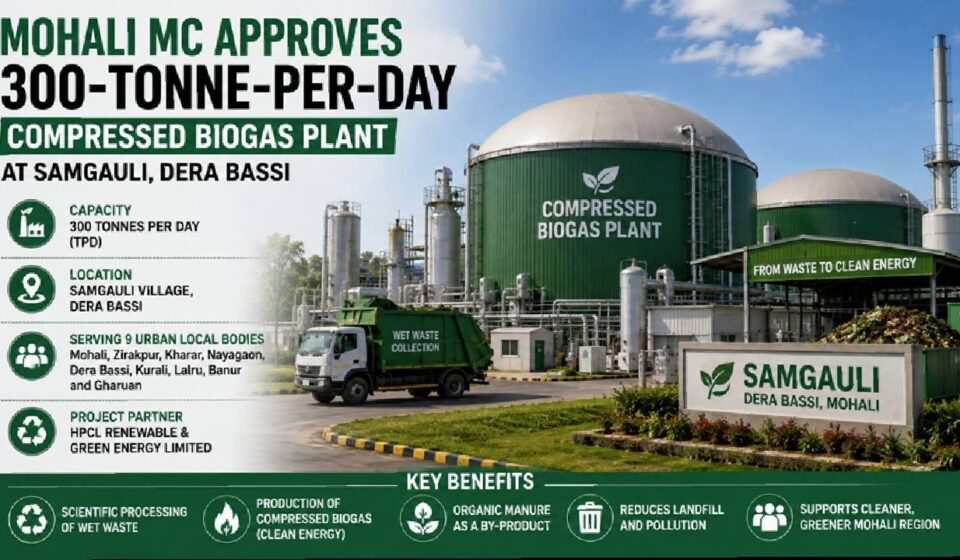

Mohali: The Mohali Municipal Corporation has approved a proposal to establish a 300-tonne-per-day Compressed Biogas (CBG) plant at Samgauli village in Dera Bassi, marking a significant step towards improving scientific waste management and promoting renewable energy in the Mohali region.
Table Of Content
- Plant to Serve Multiple Urban Local Bodies
- 300 Tonnes of Wet Waste to Be Processed Daily
- Land Proposed at Samgauli
- HPRGE to Handle Project Development
- Regular Supply of Segregated Waste Important
- Road Access and Other Infrastructure
- Samgauli Has Been Considered for Waste Projects Earlier
- Greater Mohali Faces Growing Waste-Management Needs
- Focus on Scientific Processing of Wet Waste
- Potential Benefits for the Mohali Region
- Project Still Requires Further Formalities
- Execution Will Be Key to the Project’s Success
- A Potential Step Towards Greener Waste Management
- Conclusion
The proposed facility is expected to process around 300 tonnes of segregated wet waste every day and convert biodegradable municipal waste into compressed biogas and fermented organic manure. The project is being planned in collaboration with HPCL Renewable & Green Energy Limited (HPRGE), a wholly owned subsidiary of Hindustan Petroleum Corporation Limited.
Plant to Serve Multiple Urban Local Bodies
The proposed CBG plant is planned as a regional waste-processing facility and is not intended to serve Mohali city alone. Wet waste from nine urban local bodies is proposed to be transported to the Samgauli facility.
These include Mohali, Zirakpur, Kharar, Nayagaon, Dera Bassi, Kurali, Lalru, Banur and Gharuan.
The regional approach is expected to help participating civic bodies manage their biodegradable waste through a common processing facility while reducing dependence on conventional waste-disposal methods.
300 Tonnes of Wet Waste to Be Processed Daily
The facility will focus specifically on segregated wet and biodegradable municipal waste. The waste will undergo biological processing to produce compressed biogas along with fermented organic manure.
The proposed system could help turn a significant portion of municipal waste into useful resources rather than sending it directly for disposal.
Compressed biogas can be used as a fuel, while the organic residue generated through the processing system can be converted into manure. This gives the project both a waste-management and renewable-energy component.
Land Proposed at Samgauli
The Municipal Corporation has around 39 acres of land at Samgauli. Under the proposal, approximately 15 to 20 acres may be allotted for the CBG project.
The land is proposed to be provided for a period of 30 years, subject to the terms, conditions and approvals that will be finalised between the concerned authorities and the project developer.
The availability of a sizeable land parcel at Samgauli is expected to provide space for the main processing plant, machinery, utilities and other supporting infrastructure.
HPRGE to Handle Project Development
Under the proposal, HPCL Renewable & Green Energy Limited is expected to undertake the feasibility study, soil investigation and project planning.
The company is also expected to bear the capital expenditure associated with establishing the facility. This includes installing the required plant, machinery and supporting utilities.
HPRGE would also be responsible for the operation and maintenance of the facility once it becomes operational, subject to the final agreement and project conditions.
Regular Supply of Segregated Waste Important
One of the most important requirements for the success of the project will be a consistent supply of properly segregated wet waste.
The participating urban local bodies will need to ensure that biodegradable waste is collected separately and transported to the Samgauli facility in a suitable condition.
Proper waste segregation at source will therefore remain an important factor in determining how efficiently the proposed plant can operate.
If wet waste continues to be mixed with plastic, construction material and other non-biodegradable waste, processing efficiency could be affected. Strengthening segregation and collection systems across the participating urban areas will consequently be essential.
Road Access and Other Infrastructure
The proposal also includes arrangements for road connectivity, statutory permissions and utility services required for the facility.
These arrangements will need to be worked out between the Municipal Corporation, HPRGE and the participating civic bodies before the project moves towards construction and commissioning.
The project will also require the completion of necessary government and statutory approvals.
Samgauli Has Been Considered for Waste Projects Earlier
The latest proposal is not the first waste-management project considered for the Samgauli site.
The location has previously been associated with different proposals aimed at improving waste processing in the Greater Mohali region. Official records have also reflected an earlier Waste-to-CBG project proposal, for which a tender process had been initiated in 2024.
The latest proposal represents another attempt to develop a more organised waste-processing solution at the site.
Greater Mohali Faces Growing Waste-Management Needs
The proposal comes at a time when waste management remains an important challenge for the expanding Mohali urban region.
The growth of residential areas, commercial activity and population across Mohali, Zirakpur, Kharar and neighbouring towns has increased the amount of municipal waste generated each day.
A regional facility capable of processing hundreds of tonnes of wet waste could therefore play an important role in reducing pressure on existing waste-management systems.
Focus on Scientific Processing of Wet Waste
Unlike conventional disposal methods, the proposed CBG plant would focus on recovering value from biodegradable waste.
Organic waste can be processed through biological treatment to generate biogas. After purification and upgrading, the gas can be used as compressed biogas, while the remaining organic material can be processed into manure.
This approach can help create a resource-recovery model, where municipal waste becomes a source of energy and useful agricultural products.
Potential Benefits for the Mohali Region
If implemented successfully, the proposed facility could provide several benefits to the region.
These could include:
- Better processing of segregated wet waste
- Reduction in the quantity of biodegradable waste requiring disposal
- Production of compressed biogas
- Generation of fermented organic manure
- Greater use of renewable energy resources
- Regional coordination among multiple urban local bodies
- Reduced pressure on conventional waste-disposal systems
- More organised scientific waste management
The project could therefore become an important part of the region’s long-term strategy for handling increasing quantities of municipal waste.
Project Still Requires Further Formalities
Although the Municipal Corporation has approved the proposal, several procedural steps remain before construction can begin.
The next stages are expected to include land demarcation, feasibility assessment, preparation of project documents and completion of required formalities.
Agreements between the Municipal Corporation and HPRGE will also need to be finalised. These may include an MoU, arrangements for the supply of segregated wet waste and a long-term land lease, subject to the applicable approvals.
The project will also require the necessary statutory and government clearances.
Execution Will Be Key to the Project’s Success
The approval of the proposal represents an important step, but the actual impact of the project will depend on its timely execution and effective operation.
A CBG plant of this scale requires a reliable supply chain. Waste must be properly segregated, collected, transported and delivered to the facility on a regular basis.
Coordination among all nine participating urban local bodies will therefore be important.
The authorities will also need to ensure that transportation arrangements, road access and environmental safeguards are properly managed once the plant becomes operational.
A Potential Step Towards Greener Waste Management
For Mohali and neighbouring towns, the proposed Samgauli CBG plant could provide an opportunity to address two major urban challenges together — growing municipal waste and the need for cleaner energy solutions.
By converting biodegradable waste into compressed biogas and organic manure, the project aims to move towards a system where waste is treated as a resource rather than simply something that needs to be discarded.
The regional nature of the project could further strengthen its importance by bringing waste from multiple urban areas under one organised processing system.
Conclusion
The proposed 300-tonne-per-day Compressed Biogas plant at Samgauli marks a significant development in the Mohali region’s approach to waste management and renewable energy.
With waste from nine urban local bodies planned to be processed at the facility, the project has the potential to become an important regional waste-processing centre. However, its success will depend on proper waste segregation, reliable transportation, timely approvals, effective execution and long-term operation.
If implemented as planned, the Samgauli facility could help Mohali and surrounding towns reduce the burden of biodegradable waste while producing useful energy and organic manure. The project therefore represents a potential shift towards a more scientific, resource-oriented and sustainable approach to municipal waste management in the region.