


Punjab Bets on Mohali to Attract Global Capability Centres With 50% Cost Advantage

Mohali:
Table Of Content
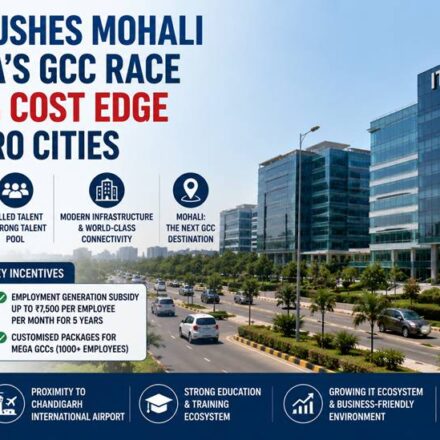
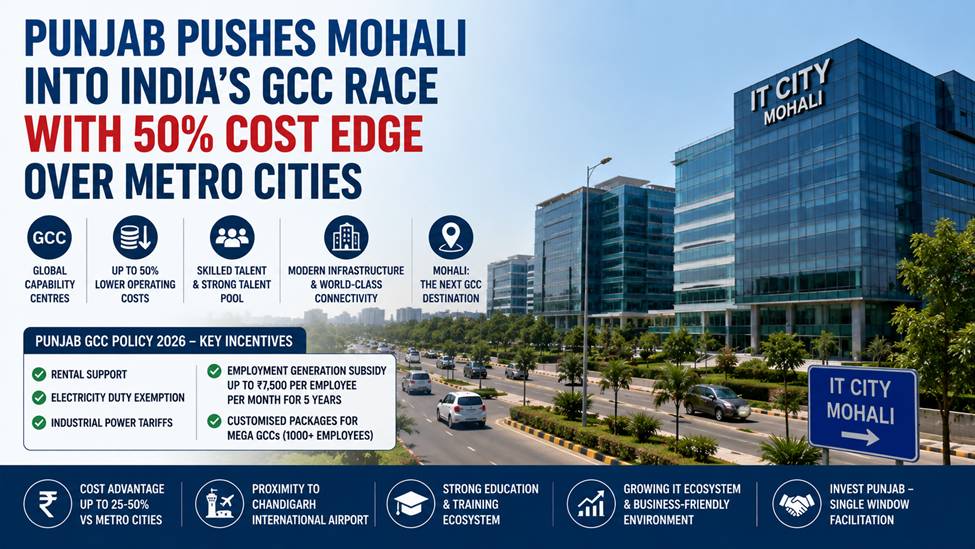
Punjab is stepping up efforts to position Mohali as one of India’s emerging destinations for Global Capability Centres (GCCs), with the state government highlighting the city’s comparatively lower operating costs, skilled workforce, connectivity and growing technology ecosystem as key advantages over established metropolitan hubs.
The initiative comes at a time when companies are increasingly looking beyond traditional technology centres such as Bengaluru, Hyderabad, Pune, Chennai and Gurugram for their next phase of expansion. Industry estimates indicate that Tier-II cities can offer substantial operating-cost savings compared with Tier-I metropolitan locations, particularly in areas such as office space, talent and other operational expenses.
Mohali is now being projected as a city capable of combining the infrastructure and talent associated with major technology centres with a potentially lower cost of operation.
Punjab Industries and Commerce Minister Aman Arora recently led an investment outreach programme in Bengaluru to attract global companies and technology investments to the state. The delegation interacted with companies and industry organisations working in areas including GCCs, IT and IT-enabled services, research and development and emerging technologies.
The state’s investment pitch is based on the proposition of providing “Tier-I capabilities at Tier-II costs.” The objective is to offer companies access to skilled professionals and modern infrastructure while maintaining a more competitive operating-cost structure than some of India’s largest technology hubs.
Mohali’s Growing Technology Ecosystem
Mohali already has an established technology and commercial base, with IT companies, educational institutions, startups and professional services firms operating across the wider Tricity region. The city’s expanding commercial infrastructure is also creating additional opportunities for technology companies looking for larger operational facilities.
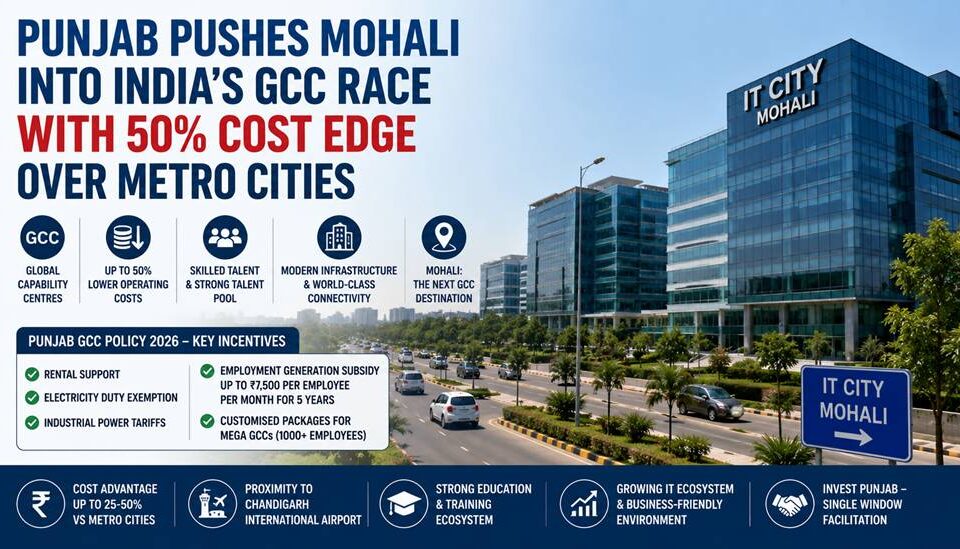
The Punjab GCC Policy 2026 provides a framework of incentives for eligible Global Capability Centres. These include provisions related to rental support, electricity-duty exemptions, industrial power tariffs and employment-generation subsidies, subject to the applicable eligibility conditions.
The policy also provides for customised incentive packages for the first three mega GCC projects employing more than 1,000 people, potentially making the state more competitive in attracting large-scale operations.
For eligible GCC units, the policy provides an employment-generation subsidy of ₹7,500 per employee per month for five years, subject to the prescribed conditions. Qualifying units with a minimum of 100 seats can also benefit from rental-support provisions.
Talent Pool Gives Mohali an Advantage
Cost is only one part of Punjab’s pitch. The government is also highlighting the availability of skilled talent in the wider Tricity region.
Mohali and neighbouring Chandigarh have access to engineering, technology and management professionals through universities, engineering colleges, technical institutes, ITIs and other educational institutions. This talent base could be particularly important for GCCs operating in specialised fields such as software engineering, data analytics, artificial intelligence, cybersecurity and research and development.
For global companies, the ability to recruit and retain skilled employees is increasingly becoming as important as the cost of setting up an office. Mohali’s combination of educational institutions and proximity to Chandigarh provides the region with a potential advantage in this area.
Connectivity Strengthens the Investment Pitch
Another major factor being highlighted is Mohali’s connectivity.
The city’s proximity to Chandigarh International Airport provides access to domestic and international destinations, which can be important for GCC operations involving frequent travel by senior executives, technical teams and clients.
Mohali’s location within the Tricity also provides companies access to established urban infrastructure, healthcare, education, residential facilities and commercial services.
The availability of developed commercial areas and newer development zones could further allow companies to expand their operations as their workforce and business requirements grow.
Focus Beyond Traditional IT Services
Punjab’s technology strategy is not limited to conventional IT and IT-enabled services. The state is also looking to attract investments in artificial intelligence, data analytics, research and development, semiconductor-related activities and other emerging technologies.
For Mohali, this could create opportunities to develop a more diversified technology ecosystem rather than depending primarily on traditional software-service companies.
A stronger GCC presence could also benefit the local startup ecosystem. Professionals with experience in multinational technology companies may go on to establish startups, while local technology firms could potentially become vendors and service providers for larger global organisations.
Wider Economic Impact for Mohali
The establishment of major GCCs could have an impact beyond direct employment.
Large technology centres can generate additional demand for office spaces, facility management, hospitality, transportation, technology services, training institutions and other supporting businesses. This could strengthen the wider commercial economy of Mohali and surrounding areas.
The entry of global companies could also provide local professionals with opportunities to work on international projects without having to relocate to traditional technology metros.
For young professionals in Punjab, the expansion of GCCs could therefore create new career opportunities in areas such as artificial intelligence, software development, cloud computing, cybersecurity, finance, analytics and research.
Competition Among Indian Cities
Despite these advantages, Mohali will face strong competition from other Indian cities seeking to attract GCC investments.
Several Tier-II and emerging technology locations across the country are offering companies combinations of lower costs, incentives, skilled talent and improving infrastructure. This means Punjab will need to compete on more than just operating costs.
Companies evaluating Mohali are likely to consider factors such as talent availability, office infrastructure, connectivity, quality of life, ease of doing business, policy stability and the ability to scale operations over the long term.
The successful implementation of policy incentives and the speed with which approvals and infrastructure requirements are handled will therefore be important in converting investment proposals into actual projects.
Mohali’s Opportunity in the GCC Expansion
The broader GCC industry is increasingly expanding beyond India’s traditional metropolitan technology hubs. Rising costs and competition for skilled professionals in established centres are encouraging companies to explore alternative locations.
This shift presents Punjab with an opportunity to position Mohali as a competitive destination for the next generation of global technology operations.
The state government’s investment outreach, combined with the GCC Policy 2026 and Mohali’s existing technology ecosystem, is aimed at attracting companies that require skilled talent, modern infrastructure and competitive operating costs.
If these efforts translate into significant investments, Mohali could gradually evolve from a regional IT centre into a more prominent hub for GCCs, artificial intelligence, research, digital services and emerging technologies.
The challenge now will be to maintain the city’s cost advantage while continuing to improve infrastructure, talent development, connectivity and business-support systems.
With Punjab actively pursuing global investors and promoting a dedicated policy framework, Mohali is increasingly being positioned as a serious contender in India’s expanding Global Capability Centre landscape.