



Mohali:
Table Of Content
- Waste From Nine Urban Local Bodies to Be Processed
- 15 to 20 Acres Proposed for the Project
- HPRGE to Undertake Development and Operations
- Focus on Scientific Waste Management
- Civic Bodies to Support Infrastructure
- Formal Agreements Expected
- Regional Approach to Wet-Waste Management
- Fresh Push After Earlier Proposal
- Potential Benefits for Mohali Region
- Implementation Will Be Key
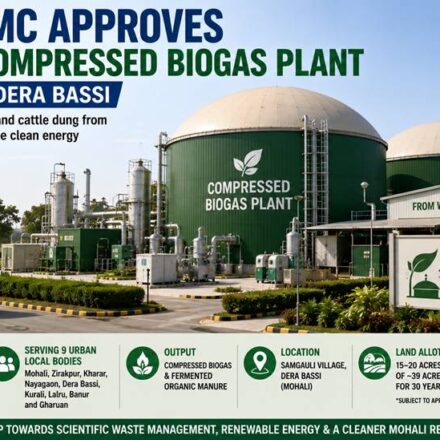
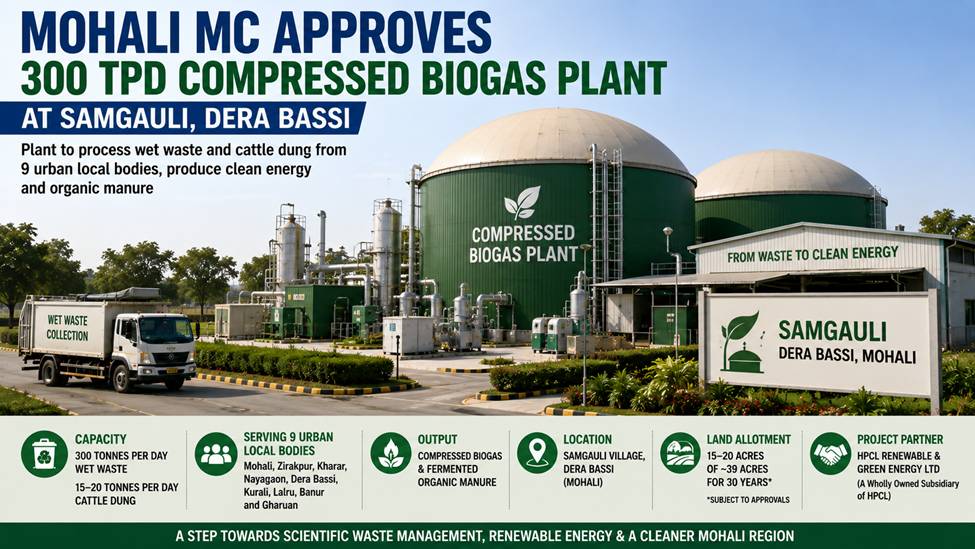
The Mohali Municipal Corporation (MC) has approved a proposal to establish a 300-tonne-per-day compressed biogas (CBG) plant at Samgauli village in Dera Bassi, marking an important step towards developing a regional system for scientific processing of wet municipal waste and converting biodegradable waste into renewable energy and organic manure.
The proposed facility will be developed in partnership with HPCL Renewable & Green Energy Ltd (HPRGE), a wholly owned subsidiary of Hindustan Petroleum Corporation Ltd. The project is aimed at creating a coordinated mechanism for processing segregated organic waste generated across the wider Mohali region.
Waste From Nine Urban Local Bodies to Be Processed
Under the proposal, the plant will receive segregated wet waste from nine urban local bodies. These include Mohali, Zirakpur, Kharar, Nayagaon, Dera Bassi, Kurali, Lalru, Banur and Gharuan.
Around 300 tonnes of segregated wet waste could be supplied to the facility every day. The proposed project is also expected to receive approximately 15 to 20 tonnes of cattle dung daily, which would form part of the organic feedstock for the facility.
The biodegradable material will be processed to produce compressed biogas and fermented organic manure. The approach is intended to recover useful resources from municipal waste instead of sending organic material directly for conventional disposal.
15 to 20 Acres Proposed for the Project
The CBG plant is proposed to be established on land owned by the Mohali Municipal Corporation at Samgauli.
The corporation has approximately 39 acres of land at the location. Under the proposal, around 15 to 20 acres may be allotted for the CBG project.
The land is proposed to be made available to HPRGE for a period of 30 years, subject to the applicable terms and conditions, feasibility assessment and necessary approvals. The final land arrangement will be determined through formal agreements between the corporation and the company.
HPRGE to Undertake Development and Operations
HPRGE is expected to carry out the feasibility study, soil investigation and project planning for the proposed facility.
The company will also be responsible for the capital expenditure required for developing the project. Its responsibilities are expected to include construction of the facility, installation of plant and machinery, development of associated utilities and subsequent operation and maintenance.
A reliable supply of properly segregated wet waste will be crucial for the plant’s successful operation.
The participating urban local bodies will therefore need to ensure that organic waste is collected separately and transported to the facility in a suitable condition.
Focus on Scientific Waste Management
The proposed project is aimed at addressing one of the major challenges faced by rapidly growing urban areas — the increasing volume of municipal waste.
Separating wet waste from other forms of municipal waste allows biodegradable material to be treated through biological processing. The proposed Samgauli facility would use this material to generate CBG and organic manure, potentially reducing the volume of organic waste requiring conventional disposal.
Compressed biogas can be used as a fuel, while the organic residue generated during processing can be utilised as manure. This creates the possibility of generating both energy and agricultural value from municipal waste.
Civic Bodies to Support Infrastructure
The participating local bodies will also have an important role in supporting the project.
Arrangements will need to be made for road access, electricity, water, transportation of wet waste and other basic infrastructure. Necessary statutory and regulatory clearances will also have to be obtained before the facility can move towards construction and operation.
The corporation’s approval is therefore an important milestone, but it does not mean that the plant is ready for immediate construction.
The proposal will now proceed through various stages, including land demarcation, feasibility assessment, formal agreements, statutory approvals and infrastructure planning.
Formal Agreements Expected
The next phase is expected to include formal arrangements between the Municipal Corporation and HPRGE.
These may include a Memorandum of Understanding (MoU), wet-waste supply arrangement and long-term land lease agreement, subject to the required approvals and finalisation of terms.
The agreements will be important for defining the responsibilities of the company, Mohali MC and the participating urban local bodies.
Regional Approach to Wet-Waste Management
One of the key features of the proposal is its regional character.
Instead of each urban local body handling biodegradable waste independently, the proposed facility could provide a centralised processing system for nine urban local bodies.
Such an arrangement could help improve coordination in the collection, transportation and processing of wet waste across the Mohali region.
However, the effectiveness of the system will depend heavily on proper segregation at source. If wet waste is mixed with plastic, construction material or other non-biodegradable waste, the efficiency of the processing facility could be affected.
Fresh Push After Earlier Proposal
The latest proposal follows an earlier initiative related to establishing a municipal solid-waste-based CBG facility in the region.
HPRGE had submitted an earlier proposal to the Punjab Municipal Infrastructure Development Company in 2024. The latest approval provides a fresh opportunity to move the project forward, although several procedural and technical requirements remain to be completed.
The project will therefore require continued coordination between the Municipal Corporation, HPRGE and the participating urban local bodies.
Potential Benefits for Mohali Region
If implemented as proposed, the Samgauli CBG plant could become an important component of the region’s waste-management infrastructure.
The facility could help reduce the amount of biodegradable waste requiring conventional disposal while creating a source of renewable fuel and organic manure.
It could also encourage urban local bodies to strengthen door-to-door collection, source segregation and separate transportation of wet waste.
For residents of Mohali and surrounding towns, better management of organic waste could contribute to cleaner public spaces and more organised waste-processing systems.
Implementation Will Be Key
Despite the potential benefits, the success of the project will ultimately depend on effective execution.
Timely completion of feasibility studies, land arrangements, statutory clearances and supporting infrastructure will be necessary. Equally important will be the ability of participating civic bodies to consistently supply properly segregated wet waste and maintain an efficient transportation network.
The project will also require long-term operational discipline to ensure that the facility functions at or near its planned capacity.
For the Mohali region, the proposed plant represents a shift towards viewing municipal waste not only as a disposal challenge but also as a potential resource for renewable energy and organic products.
If successfully implemented, the 300 TPD Samgauli CBG project could provide a more resource-oriented approach to wet-waste management, bringing together waste processing, renewable energy generation and organic manure production under a single regional system.