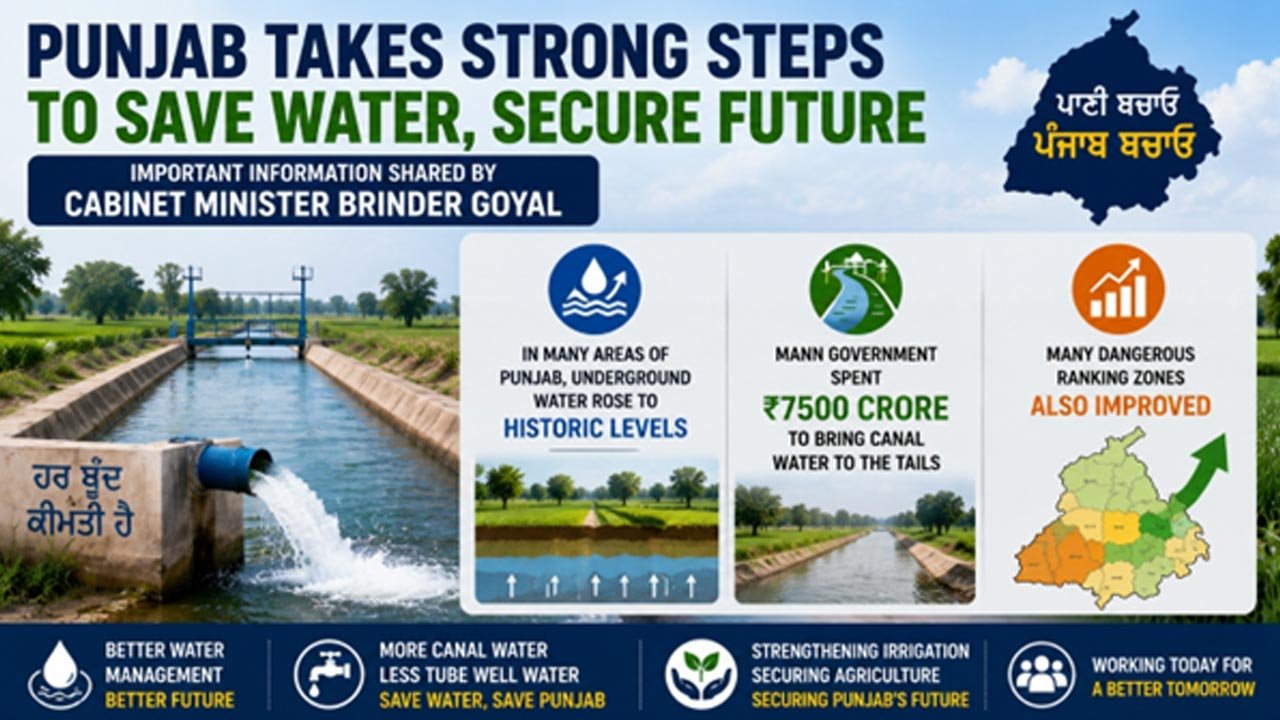
Punjab: Punjab Water Resources Minister Brinder Kumar Goyal has highlighted the state government’s ongoing efforts to strengthen canal irrigation and reduce agriculture’s dependence on groundwater, saying that improvement in groundwater levels has been observed in several areas of the state.
Addressing a press conference, Goyal outlined the initiatives undertaken by the Bhagwant Mann-led Punjab Government to increase the availability and utilisation of canal water for agriculture. He said the government is focusing on expanding irrigation coverage, restoring damaged watercourses and improving the distribution network so that canal water reaches farmers, including those located at the tail ends of irrigation systems.
According to the minister, around ₹7,500 crore has been spent on projects aimed at improving the utilisation of river water for irrigation and extending canal-water access to agricultural areas. The investment includes strengthening existing irrigation infrastructure and improving the network through which water is supplied to farmland.
Punjab has traditionally depended heavily on groundwater for agricultural irrigation, particularly through tube wells. The continued extraction of groundwater over several decades has contributed to water-level decline in many parts of the state, making conservation and alternative irrigation sources increasingly important.
Goyal said expanding canal irrigation is therefore a key component of the government’s water-management strategy. By making surface water more accessible, the government aims to reduce pressure on groundwater resources and provide farmers with a more sustainable source of irrigation.
One of the projects highlighted by the minister is in the Banga constituency, where canal irrigation has reportedly been extended to 4,890.91 acres covering 55 villages. The project has provided these agricultural areas with access to canal water, with supporting infrastructure developed to improve water distribution.
The work includes the construction of pucca watercourses and underground pipelines. Such systems can help improve the efficiency of irrigation networks by ensuring that water is transported more effectively from canals to agricultural fields, particularly in areas located farther from the main channels.
The government has also been working on the restoration of older canals and watercourses. Infrastructure that had remained damaged or non-functional for extended periods is being repaired or restored as part of the broader irrigation programme.

Punjab Government Schools Get New Focus Under Mann Government’s Education Reforms
Punjab News: Government schools across Punjab have witnessed significant changes in recent years as the state government has…
Continue readingAccording to Goyal, the restoration and strengthening of watercourses is important because simply increasing the availability of canal water does not guarantee that it will reach every farm. Efficient distribution and regular maintenance are essential for ensuring equitable access across an irrigation command area.
Focus on Groundwater Conservation
Punjab’s groundwater situation remains a major concern, with several agricultural areas facing significant levels of groundwater stress. The state has historically relied on intensive groundwater extraction to support farming, making long-term conservation a priority for policymakers.
The government’s approach combines canal expansion, groundwater recharge and improved water-use management. The objective is to increase the share of surface water used for irrigation while creating conditions that can support the replenishment of underground water reserves.
Recharge initiatives form another part of the strategy. Ponds, canals and other water-retention structures can contribute to groundwater replenishment when they are appropriately designed, maintained and connected with local water systems.
In several areas, the government has been exploring or implementing projects involving ponds and recharge structures. These initiatives are intended to increase the amount of water that can be retained locally and potentially improve groundwater conditions over time.
Goyal said that greater availability of canal water could help farmers gradually reduce their dependence on tube wells. A shift towards surface-water-based irrigation, combined with more efficient farming and irrigation practices, could help reduce the pressure on groundwater reserves.
Challenges Remain
Despite the reported improvement in some areas, Punjab’s groundwater challenge remains significant. Groundwater conditions differ from one district and agricultural block to another, and long-term improvement will depend on sustained conservation efforts.
Canal irrigation by itself cannot resolve the state’s groundwater problem. Crop diversification, efficient irrigation techniques, rainwater conservation, groundwater recharge and responsible water use will also be important in reducing extraction.

Kulwant Singh Interacts with Residents, Assures Resolution of Genuine Public Issues
Mohali: MLA Kulwant Singh met residents from different parts of the Mohali constituency during a public interaction programme…
Continue readingThe pattern of agricultural cultivation is particularly relevant because water-intensive crops have historically placed substantial pressure on groundwater resources. A broader shift towards crops that require less irrigation could complement the government’s infrastructure initiatives.
For farmers, reliable canal water can provide an alternative to groundwater-based irrigation and potentially reduce the need for continuous operation of tube wells. For the state, greater utilisation of surface water could help slow the depletion of underground reserves.
However, the effectiveness of the programme will depend on several factors, including the regular maintenance of canals and watercourses, fair distribution of available water, efficient irrigation practices and actual reductions in groundwater extraction.
The government has therefore positioned canal expansion as part of a wider water-conservation strategy rather than simply an infrastructure-development programme. Ensuring that irrigation water reaches underserved areas, particularly farms located at the tail ends of canal networks, remains an important objective.
Towards Better Water Security
The reported improvement in groundwater levels in some areas has provided encouragement for the state’s water-conservation efforts. However, maintaining and expanding these gains will require continued investment and long-term planning.
The Water Resources Department’s focus is increasingly centred on making better use of Punjab’s surface-water resources while reducing excessive dependence on underground reserves. Strengthening canal networks, restoring watercourses and developing recharge infrastructure are being pursued alongside broader efforts to promote more efficient water use.
As additional irrigation and recharge projects are completed, the government hopes to extend canal-water access to more agricultural areas and reduce pressure on groundwater.
For Punjab, where agriculture remains a major user of water, the success of these measures could have long-term implications for the state’s environmental and agricultural sustainability. The immediate focus remains on improving irrigation infrastructure, while the larger objective is to build a more balanced and sustainable water-management system for the future.




Comments