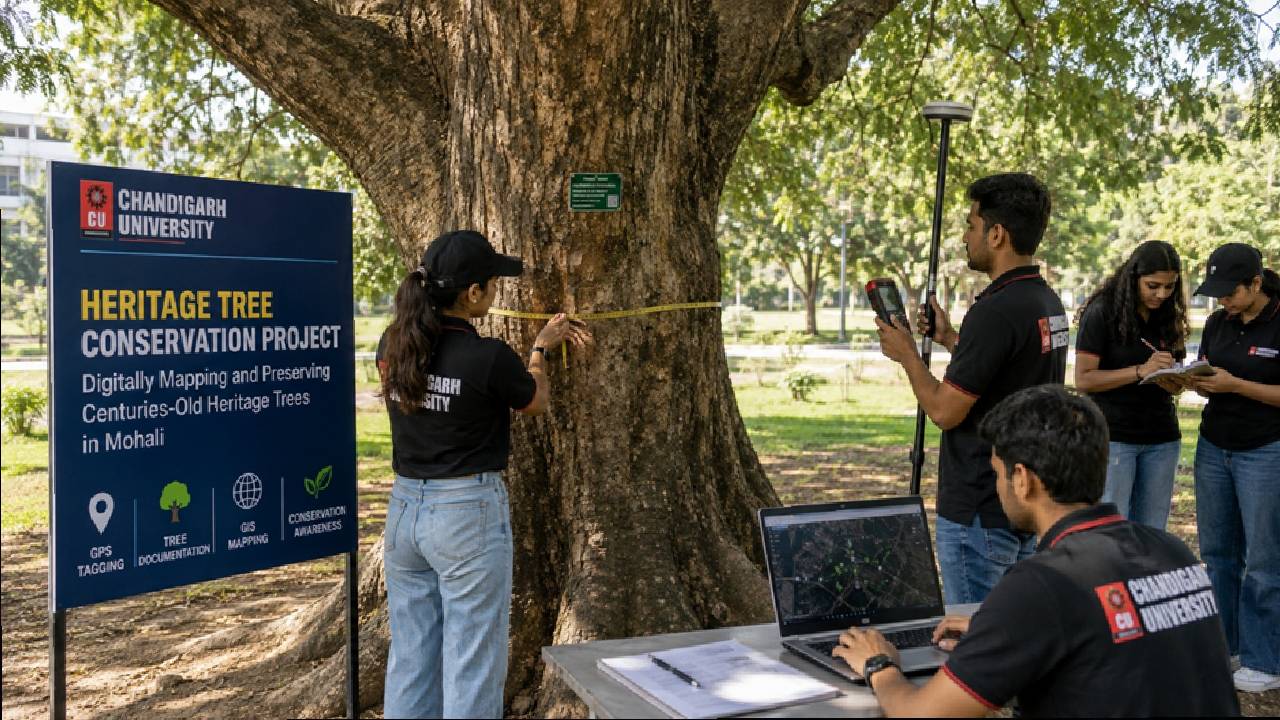
In a major initiative to promote environmental sustainability and protect the region’s natural heritage, Chandigarh University has launched a Heritage Tree Conservation Project aimed at identifying, documenting, and digitally preserving centuries-old trees across SAS Nagar Mohali and nearby areas. The project combines modern geospatial technology with environmental research to create a comprehensive digital database of historically and ecologically significant trees.
The initiative will use Geographic Information Systems (GIS), GPS mapping, drone-assisted surveys, and digital documentation to record the exact location, species, estimated age, physical dimensions, health status, and ecological importance of heritage trees. The digital inventory is expected to serve as a valuable resource for researchers, environmental planners, forest officials, and local authorities involved in urban conservation and biodiversity management.
According to university officials, the project has been designed to preserve living natural heritage while supporting sustainable urban development. Many of the identified trees have stood for decades or even centuries and continue to play an essential role in maintaining ecological balance, improving air quality, supporting biodiversity, reducing urban heat, and enhancing groundwater recharge. Several of these trees also hold historical, cultural, and community significance, making their preservation equally important from a heritage perspective.

Punjab Government Schools Get New Focus Under Mann Government’s Education Reforms
Punjab News: Government schools across Punjab have witnessed significant changes in recent years as the state government has…
Continue readingAs part of the project, multidisciplinary teams comprising faculty members, researchers, and students will conduct extensive field surveys across Mohali and adjoining regions. Advanced mapping technologies will be used to accurately geo-tag every identified heritage tree, while a digital database will maintain detailed records that can be periodically updated to monitor tree health, environmental changes, and conservation requirements over time.
The Heritage Tree Conservation Project also focuses on increasing public awareness about the importance of protecting mature trees, particularly in rapidly urbanising areas where infrastructure development often threatens existing green cover. Through scientifically documented information and digital mapping, the initiative aims to support evidence-based environmental planning and encourage responsible development practices that safeguard valuable natural resources.
Environmental experts have appreciated the initiative, highlighting that heritage trees provide long-term ecological benefits by absorbing carbon dioxide, producing oxygen, supporting wildlife habitats, preventing soil erosion, regulating local temperatures, and contributing to healthier urban ecosystems. They believe systematic documentation of these trees will strengthen future conservation strategies while encouraging greater community participation in environmental protection.

Kulwant Singh Interacts with Residents, Assures Resolution of Genuine Public Issues
Mohali: MLA Kulwant Singh met residents from different parts of the Mohali constituency during a public interaction programme…
Continue readingThe digital database developed under the project is also expected to support academic research, biodiversity studies, climate resilience planning, and environmental education. In the coming years, the mapped information may be integrated into educational and public awareness platforms, enabling students, researchers, policymakers, and citizens to explore and learn about Mohali’s rich natural heritage through digital tools.
The initiative reflects the growing adoption of technology-driven environmental management practices, where geospatial mapping, digital monitoring, and scientific documentation are increasingly being used worldwide to improve conservation planning and resource management. Similar heritage tree mapping projects have successfully contributed to protecting valuable green assets in several countries by providing reliable data for long-term policy decisions.
With SAS Nagar Mohali continuing to witness rapid urban expansion, the need to identify and preserve its oldest trees has become increasingly significant. Chandigarh University’s Heritage Tree Conservation Project represents an important step towards balancing urban growth with environmental responsibility while ensuring that future generations continue to benefit from the city’s invaluable natural heritage.
By integrating scientific research, digital innovation, and community awareness, the university’s Heritage Tree Conservation Project is expected to strengthen biodiversity conservation, promote sustainable development, and establish a lasting framework for protecting Mohali’s centuries-old trees for years to come.



Comments