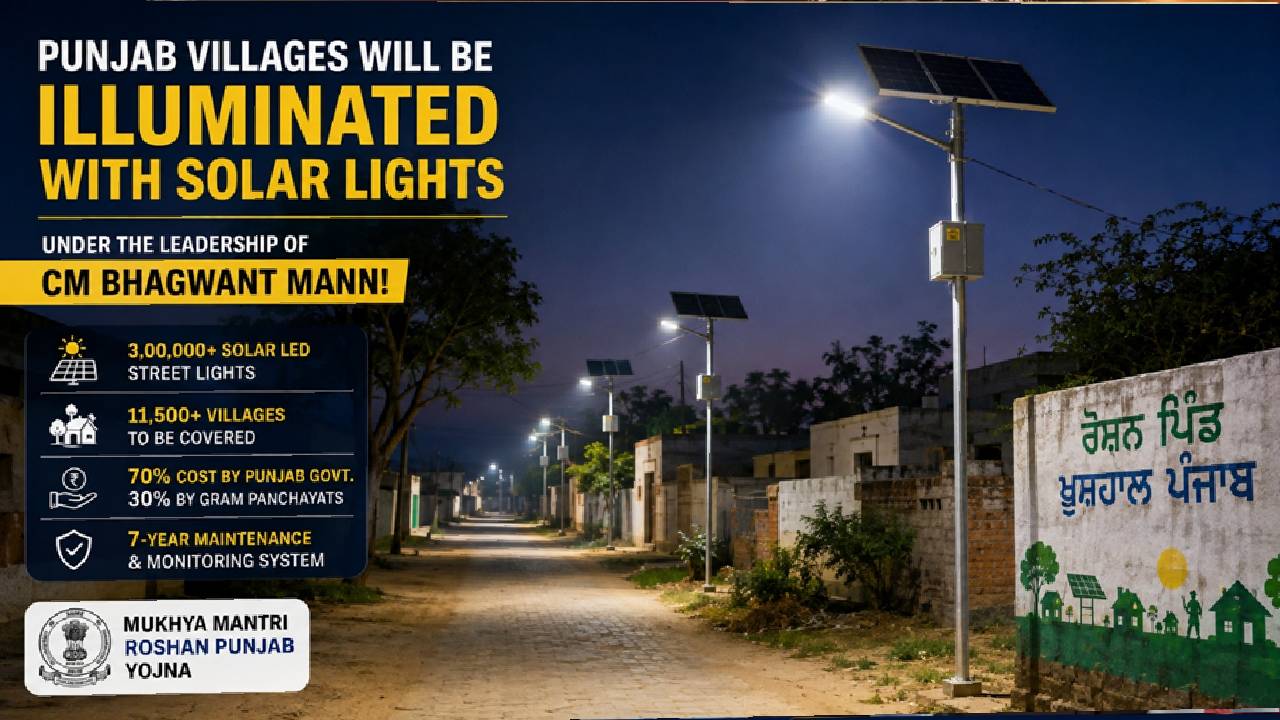
Punjab: Villages across Punjab are set to receive a major upgrade in their street-lighting infrastructure under the state government’s Mukhya Mantri Roshan Punjab Yojna. The initiative aims to install more than 3 lakh solar-powered LED streetlights across around 13,000 villages, with an estimated investment of ₹550 crore.
The programme was approved by the Punjab Cabinet under the leadership of Chief Minister Bhagwant Mann and was announced by New and Renewable Energy Minister Aman Arora. The project is being positioned as a large-scale rural infrastructure initiative that combines improved public lighting with greater use of renewable energy.
The Punjab Energy Development Agency (PEDA) has been entrusted with implementing the project. According to the announcement, installation is planned in phases between June and October 2026, covering villages across the state. :contentReference[oaicite:1]{index=1}
☀️ More Than 3 Lakh Solar LED Streetlights Planned
Under the Mukhya Mantri Roshan Punjab Yojna, more than 3 lakh solar LED streetlights are planned for rural Punjab. The government has described the initiative as one of the state’s major rural lighting programmes, aimed at providing reliable and cost-effective lighting in village areas.
Solar-powered lights have been selected because they can operate without relying on conventional grid electricity for their lighting function. This can make them particularly useful for rural locations where maintaining conventional street-lighting infrastructure may be difficult or expensive.
The project is also expected to reduce recurring electricity-related costs associated with conventional streetlights while encouraging the use of clean and renewable energy in public infrastructure.
💰 Government to Bear 70% of the Cost
One of the significant changes under the new programme is the revised funding arrangement between the state government and Gram Panchayats. Under the new model, the Punjab Government will contribute 70 per cent of the cost, while the respective Gram Panchayats will contribute the remaining 30 per cent.
The revised arrangement is intended to reduce the financial burden on village-level bodies. Earlier, Panchayats were required to bear a larger share of the expenditure for street-light installation. The new 70:30 model is expected to make participation easier for Gram Panchayats across the state. :contentReference[oaicite:2]{index=2}
📍 Geo-Tagging and Centralised Monitoring
The programme also includes a technology-based monitoring system. The installed streetlights are planned to be geo-tagged so that their locations can be digitally recorded and monitored.
A centralised monitoring mechanism will allow authorities to keep track of the installed lights and their functioning. The system is also expected to make it easier to identify faulty lights and respond to complaints from residents.
The initiative includes an IVR-based complaint mechanism, providing a channel through which issues related to streetlights can be reported to the concerned authorities.
🔧 Seven-Year Maintenance Arrangement
Long-term maintenance has been included as an important component of the project. The new solar streetlights will have a seven-year annual maintenance contract, with provisions for repairing or replacing faulty lights.
Punjab Government Schools Get New Focus Under Mann Government’s Education Reforms
Punjab News: Government schools across Punjab have witnessed significant changes in recent years as the state government has…
Continue readingAccording to the announcement, malfunctioning lights are expected to be addressed within a defined timeframe, with a provision for replacement within three days in case of a fault. This maintenance mechanism is intended to prevent the new infrastructure from becoming non-functional due to a lack of regular upkeep. :contentReference[oaicite:3]{index=3}
🏘️ Why Punjab Villages Need Better Street Lighting
Street lighting is an important part of basic rural infrastructure. Properly illuminated roads and public spaces can make movement easier after sunset and improve convenience for residents travelling through village streets.
Better lighting can also contribute to a greater sense of safety, particularly for women, children and elderly residents who may need to move around public areas during evening hours.
The government has also highlighted the potential of improved lighting to support inclusivity and improve overall living conditions in rural communities.
🌱 Focus on Renewable Energy
The Mukhya Mantri Roshan Punjab Yojna also reflects Punjab’s wider focus on renewable energy and solar-based infrastructure. By using solar-powered LED lights for village streets, the programme seeks to combine basic infrastructure development with cleaner energy solutions.
Solar streetlights can operate independently of conventional electricity supply for their lighting needs, making them suitable for areas where extending or maintaining conventional electrical infrastructure may be challenging.
The initiative therefore has both an infrastructure and an environmental dimension, with the government seeking to improve rural amenities while encouraging greater adoption of renewable energy.
💡 Replacement of Old and Defunct Streetlights
The new programme also comes against the backdrop of ageing rural street-lighting infrastructure. According to the state government’s announcement, only around 1.14 lakh streetlights had been installed in villages over the previous 70 years, with many of those lights now non-functional.
The new programme is intended to create a much larger and more standardised network of solar LED streetlights across rural Punjab. The combination of new installations, geo-tagging and long-term maintenance is designed to improve the reliability of village lighting infrastructure. :contentReference[oaicite:4]{index=4}
🛣️ Potential Benefits for Rural Communities
The impact of the programme could extend beyond street visibility. Better-lit roads and public spaces may make it easier for residents to access shops, community facilities and other local services after sunset.
Improved lighting can also support evening economic activity in villages. Small shops and local businesses may benefit from better-lit surroundings, while residents can have greater convenience when travelling within their communities.
For rural communities, the availability of dependable street lighting can therefore become an important part of improving everyday living conditions.
🏡 Role of Gram Panchayats
Gram Panchayats will have an important role in the implementation of the scheme because they are responsible for contributing 30 per cent of the project cost. Their participation can also help identify local areas where street lighting is most urgently required.
Kulwant Singh Interacts with Residents, Assures Resolution of Genuine Public Issues
Mohali: MLA Kulwant Singh met residents from different parts of the Mohali constituency during a public interaction programme…
Continue readingVillage-level involvement can help ensure that installations are planned according to local requirements, road layouts and public-use areas. Coordination between Panchayats, PEDA and other concerned authorities will be important for the smooth execution of the programme.
📅 Installation to Take Place in Phases
The government has planned the installation programme in a phased manner, with the announced implementation window running from June to October 2026.
Since the project involves more than 3 lakh streetlights across thousands of villages, its successful execution will depend on timely procurement, installation, testing, geo-tagging and maintenance arrangements.
The scale of the project makes coordination between the implementing agency, Gram Panchayats, contractors and local authorities particularly important.
🔒 Focus on Safety and Quality of Life
One of the key objectives of the scheme is to improve safety and living conditions in rural Punjab. Proper street lighting can help residents move more confidently through public spaces after dark and can make roads and village surroundings more visible.
The government has specifically highlighted the potential benefits for women and other residents who may face difficulties travelling through poorly lit areas.
At the same time, the use of solar technology is expected to provide a more cost-effective lighting solution while supporting Punjab’s renewable-energy goals.
🌟 Mukhya Mantri Roshan Punjab Yojna: A Major Rural Infrastructure Initiative
The Mukhya Mantri Roshan Punjab Yojna represents a significant push to modernise village street lighting across Punjab. With an estimated investment of ₹550 crore and more than 3 lakh solar LED streetlights planned, the programme is among the state’s major rural lighting initiatives.
The combination of solar technology, 70:30 government-Panchayat funding, geo-tagging, centralised monitoring and a seven-year maintenance arrangement is intended to create a more reliable and sustainable street-lighting system.
As installation progresses during 2026, the effectiveness of the programme will depend on the quality of equipment, timely installation, proper monitoring and consistent maintenance. If implemented as planned, the initiative could significantly improve lighting infrastructure across thousands of villages in Punjab.
📝 Conclusion
The Mukhya Mantri Roshan Punjab Yojna is set to bring a major change to rural street lighting, with more than 3 lakh solar LED streetlights planned across around 13,000 villages. With a ₹550-crore investment and a greater emphasis on renewable energy, the scheme aims to improve basic infrastructure while reducing dependence on conventional electricity.
The 70 per cent state funding contribution, seven-year maintenance arrangement, geo-tagging and centralised monitoring system are important features that could help make the new lighting network more reliable. The project is also expected to improve safety, convenience and the overall quality of life in rural communities.
As the phased installation continues through 2026, residents across Punjab will be watching how quickly the planned streetlights are installed and how effectively the maintenance and monitoring system works on the ground. :contentReference[oaicite:5]{index=5}


Comments