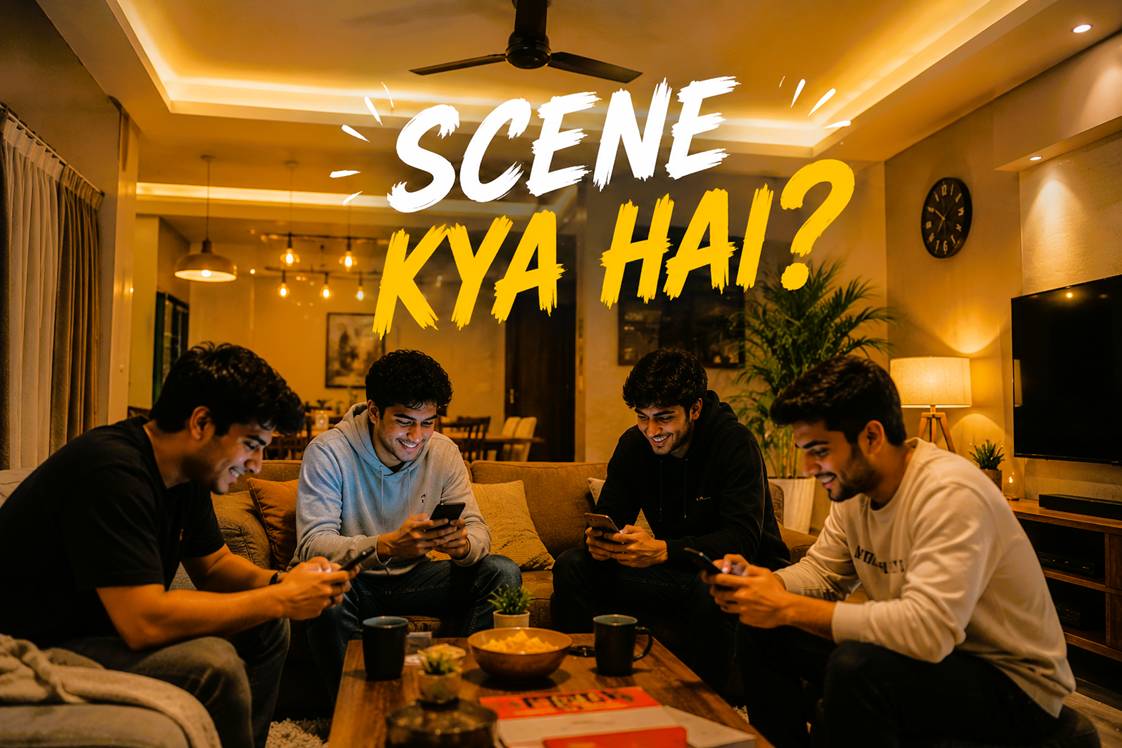
“Scene kya hai?”
That’s it.
No detailed planning.
No proper coordination.
No confirmed itinerary.
Just one message dropped into a group chat sometime after evening:
“Scene kya hai?”
And somehow, an entire night slowly builds itself around that question.
That’s what makes Mohali’s social culture feel different from heavily planned city life. Weekends here rarely operate through strict schedules. They move through momentum. One casual message turns into coffee. Coffee turns into a drive. The drive becomes food. Food becomes another stop. Somebody suddenly suggests a rooftop. Someone else calls more people. And before anyone realizes it, the night has completely changed shape three times already.
Plans in Mohali are fluid by design.
And “scene kya hai?” became the unofficial system controlling all of it.
The funny part is how emotionally loaded those four words actually are.
Sometimes they mean:
“Anybody leaving the house?”
Sometimes:
“Is the city alive tonight?”
Sometimes:
“I’m bored.”

Mohali’s New Weekend Entertainment Isn’t Planned Anymore — It’s Whatever Pop-Up Event Everyone Suddenly Shows Up To
Somebody suddenly uploads an Instagram story from a rooftop flea market. Another person shares a café hosting a…
Continue readingSometimes:
“I don’t want to sit at home today.”
And occasionally, it simply means:
“Please create a plan because nobody else in this group will.”
Yet everybody understands the language automatically.
That’s because Mohali’s entertainment culture today isn’t built around fixed events alone. It’s built around spontaneous social movement. People aren’t always searching for one perfect destination. They’re searching for energy — somewhere crowded enough, active enough, alive enough to keep the weekend feeling unfinished.
The destination itself often becomes secondary.
And that’s why entire businesses now quietly depend on this culture.
Cafés.
Gaming lounges.
Late-night food spots.
Multiplexes.
Rooftops.
Comedy nights.
Drive routes.
Dessert places.
Even parking lots.
All of them benefit from one simple social behavior:
people constantly looking for “the scene.”
The city’s younger crowd especially operates this way now. Nobody wants rigid planning anymore. Flexible plans feel more exciting because they allow nights to evolve naturally. A casual outing can suddenly become the best weekend memory simply because nobody overplanned it.
That unpredictability became part of Mohali’s entertainment identity.
Social media accelerated this even more.
One Instagram story changes plans instantly.
Someone posts a crowded café.
Another uploads rooftop clips.
A reel from a comedy night appears.
Suddenly three different friend groups start moving toward the same place within thirty minutes.
Mohali’s weekend economy now reacts in real time to social visibility.

The Multiplex Is Still Alive in Mohali — But Nobody Goes Just For The Movie Now
In Mohali now, multiplex culture has quietly evolved into something much bigger than cinema. It’s become an experience…
Continue readingPlaces don’t just become popular through advertisements anymore. They become “the scene” because enough people are visibly there already.
And once a location gains that reputation, the city keeps circulating around it for weeks.
That’s why certain spots in Mohali feel overcrowded almost overnight. Nobody officially announces them. The city collectively discovers them through stories, reels, parked cars, tagged photos, and word-of-mouth momentum.
The phrase itself also says something important about modern social behavior here.
People aren’t necessarily asking:
“What should we do?”
They’re asking:
“Where is everybody going?”
That difference matters.
Because today, Mohali’s entertainment culture is increasingly driven by participation. Young people want experiences that feel socially active, visually alive, and emotionally shared. Nobody wants to feel like they missed “the scene.”
And maybe that’s why those four words became so powerful.
Because hidden inside them is the entire psychology of modern Mohali weekends:
spontaneity,
social movement,
fear of missing out,
group energy,
and the constant search for somewhere the night still feels alive.
So every Friday and Saturday, the same cycle quietly repeats itself again.
One message.
One group chat.
One question.
“Scene kya hai?” And suddenly, the whole city starts moving.


Comments