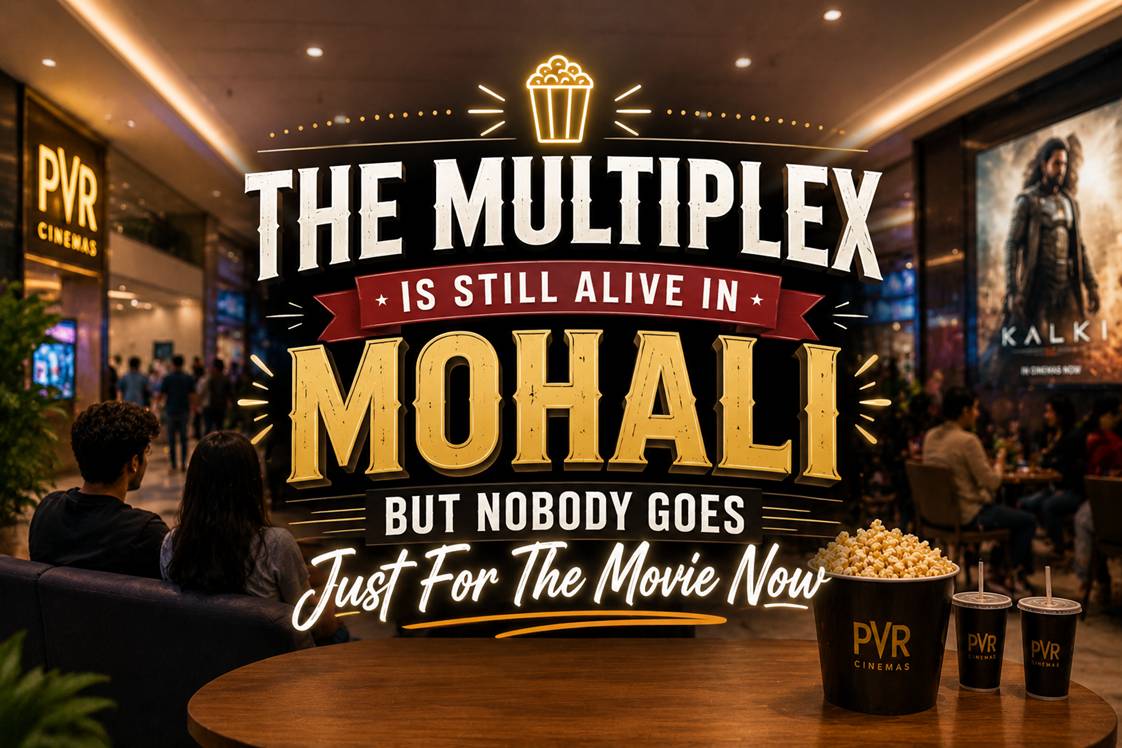
In Mohali now, multiplex culture has quietly evolved into something much bigger than cinema.
It’s become an experience people build plans around.
The movie is still important, of course. But strangely, it’s no longer the only reason people show up. Sometimes it’s not even the main reason.
Because today, a multiplex outing in Mohali feels less like “watching a film” and more like an entire evening stitched together through food courts, selfies, shopping, long conversations, parking-lot gossip, and post-movie drives that continue long after the credits end.
One booking quietly turns into a five-hour plan.
And honestly, people enjoy that version more.
You can see it every weekend across the city.
Friend groups arriving forty minutes early without urgency.
Couples spending longer choosing snacks than selecting the film itself.
People roaming around outside the theatre after the movie ends instead of heading home.
Someone clicking mirror selfies near posters.
Another group discussing dinner plans before the trailers even begin.
The multiplex became a social ecosystem.
That shift happened slowly over the last few years. Streaming platforms changed how people consume films at home, so theatres had to become emotionally different from simply “watching content.” And Mohali’s younger crowd adapted naturally.
Now people don’t go only for the screen.

Mohali’s New Weekend Entertainment Isn’t Planned Anymore — It’s Whatever Pop-Up Event Everyone Suddenly Shows Up To
Somebody suddenly uploads an Instagram story from a rooftop flea market. Another person shares a café hosting a…
Continue readingThey go for the outing attached to it.
That’s why mall multiplexes across Mohali and the tricity still stay crowded even during average movie weeks. The cinema no longer functions independently. It’s connected to cafés, dessert counters, gaming zones, shopping spaces, rooftop restaurants, and the overall feeling of “going out.”
The atmosphere itself became part of the entertainment.
Dim lobby lighting.
Crowded popcorn counters.
Movie posters glowing near escalators.
Groups dressed like they’re attending an event bigger than a film.
The slight excitement of entering a packed hall during a major release.
These details matter now.
Even average movies sometimes become memorable because the outing itself feels fun.
That’s probably the funniest thing about Mohali’s multiplex culture:
people often remember the night more than the actual movie.
Someone remembers laughing during interval conversations.
Someone remembers sneaking outside food into the hall.
Someone remembers watching a terrible film that somehow became entertaining because the group spent the entire time roasting it together.
The shared experience matters more now than cinematic perfection.
And major releases still completely transform the city.
During big Bollywood films, Punjabi movie releases, Marvel openings, or action sequels, multiplexes suddenly start behaving like event spaces instead of theatres. Crowds become louder. Late-night shows fill up faster. Food courts stay active longer. Entire friend groups arrive carrying the energy of the release itself.
Why Mohali’s Gen-Z Is Choosing Karaoke Nights, Open Mics & Activity Cafés Over Clubs
The loudest nights in Mohali are no longer happening inside clubs. They’re happening inside karaoke rooms, tiny cafés,…
Continue readingThe excitement becomes collective.
Social media amplified this culture massively.
Movie outings today are highly visual experiences. Outfit photos outside posters. Popcorn aesthetic shots. “Movie scenes” Instagram stories. Couple selfies under dim theatre lights. Reaction videos recorded immediately after the show ends. Even ticket screenshots became part of online social behavior.
People document the outing almost as much as they experience it.
And then comes the post-movie discussion culture.
Which honestly lasts longer than the film itself sometimes.
Nobody exits quietly anymore.
The reviews begin immediately while walking toward parking lots:
“First half better si.”
“Ending weak c.”
“Music ta vadia si.”
“OTT te aa jaani next month.”
The movie becomes conversation material for the rest of the night.
That’s why multiplexes still feel alive in Mohali despite the rise of OTT platforms. Streaming changed how people watch films, but it didn’t replace the social energy attached to physically going out together.
Because ultimately, Mohali multiplex culture isn’t surviving only because people love cinema.
It’s surviving because people still love shared evenings. The movie just happens to sit in the middle of them.

Comments