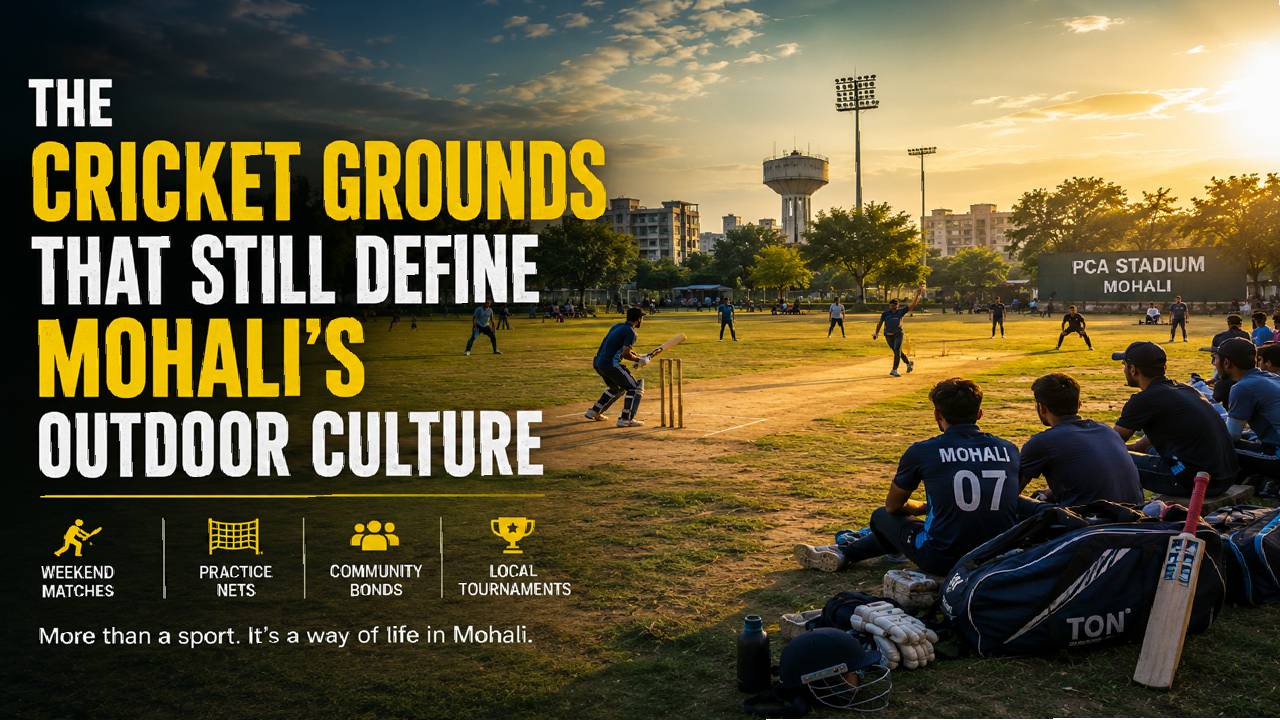
Long before Mohali became associated with wide roads, cafés, coworking spaces, or luxury apartments, the city was already deeply connected to one thing: cricket.
Not just stadium cricket.
Ground cricket.
The kind played in open fields, sector grounds, school spaces, dusty patches, and public parks where matches begin before sunrise and continue until the streetlights come on.
Even today, some of Mohali’s most active public spaces are cricket grounds.
Not because they were designed as social hubs.
But because cricket quietly turned them into one.
On weekend mornings, the city starts moving differently.
Cars carrying kits and plastic chairs begin arriving near grounds.
Teenagers mark boundaries with cones and bottles.
Parents stand near sidelines watching academy sessions.
Groups argue over batting order before the toss even happens.
And suddenly, an ordinary open field starts feeling like a full ecosystem.
That’s the thing about cricket culture in Mohali.
It doesn’t stay limited to the game itself.
It creates routines, friendships, rivalries, local identities, and entire social circles around public space.
You see it across the city.
Sector grounds occupied from early morning.
Practice nets filled before school hours.
Floodlit evening sessions after office timings.
Children playing with taped tennis balls while older groups run proper leather-ball matches nearby.
Why Mohali Feels More Walkable Than Most North Indian Cities
In most North Indian cities, walking often feels like compromise. You walk because traffic is impossible.Because parking is…
Continue readingDifferent generations sharing the same space through the same sport.
Very few public activities in modern cities still do that.
And Mohali’s connection with cricket runs deeper than most cities because the sport already exists in the city’s identity.
The presence of the PCA Stadium changed how generations here emotionally relate to cricket. Even for people who never played professionally, the game always felt physically close to the city.
Not distant.
Not aspirational.
Visible.
That visibility matters.
It made cricket feel accessible in everyday life.
And over time, the city’s open grounds absorbed that energy.
Many of these grounds now function as unofficial public gathering zones.
People don’t just come to play.
They come to watch.
To wait.
To socialize.
To spend time outdoors.
To sit after practice sessions.
To reconnect with friends every weekend.
In a city where social life increasingly happens indoors or online, cricket grounds still force physical interaction.
How Open Public Spaces Shape Social Life in Mohali
Unlike denser urban environments where most interaction shifts indoors, Mohali still has enough open movement spaces for people…
Continue readingReal conversations.
Real presence.
Real community behavior.
That’s why the atmosphere around these grounds feels different from regular parks.
There’s movement everywhere.
Appeals from one side.
Laughter from another.
Coaches shouting instructions.
Balls crossing into nearby matches.
Scooters parked around boundary edges.
People discussing IPL performances while waiting to bat next.
The space never feels static.
It feels alive.
And unlike curated urban hangout spaces, cricket grounds still feel raw and local.
Nobody is trying to perform for social media there.
People are simply participating in city life.
That authenticity is becoming rare.
Especially for younger people growing up in highly digital routines, these grounds still provide one of the few large-scale outdoor cultures left in Mohali.
A place where strangers become teammates.
Where weekends develop structure.
Where public space still revolves around activity instead of consumption.
That’s why cricket grounds continue to define Mohali’s outdoor culture. Because in many ways, they are among the last truly active public spaces the city still shares together.

Comments